

Finding an image online does not give you the right to put it in an advertisement, sales page, brochure, or product package. The U.S. Copyright Office makes the distinction unusually clear: photographs found online are generally protected by copyright, and using someone else’s photograph normally requires permission.
That is why learning how to license stock photos for commercial use is less about finding attractive images and more about understanding exactly what permission you are buying.
A legitimate stock license can cover everything from a website hero image to a national advertising campaign. But the wrong license—or a photograph with missing releases—can expose a business to copyright, privacy, publicity, or trademark problems.
What Counts as Commercial Use?
Commercial use generally means using an image in connection with business activity, promotion, sales, advertising, or another money-making purpose.
Typical examples include:
- Digital advertisements
- Company websites and landing pages
- Product packaging
- Email marketing
- Sponsored social media campaigns
- Brochures and sales materials
- Apps and software
- Merchandise offered for sale
Simply crediting the photographer does not substitute for obtaining permission.
Under U.S. copyright law, copyright owners hold exclusive rights that include reproducing, distributing, displaying, licensing, and creating derivative works from their creations. Cornell Law School’s Legal Information Institute provides a useful overview of these rights.
Start by Matching the License to the Project
Stock agencies use different terminology, so never assume that “commercial license” has the same limits everywhere.
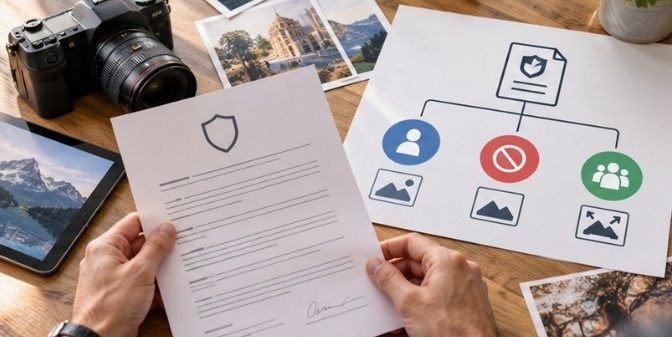
Royalty-Free Licenses
Royalty-free does not mean free. It normally means you obtain a license and can reuse the image within the license’s conditions without paying a royalty every time it appears.
This works well for routine marketing needs such as company websites, social posts, presentations, online advertisements, and printed promotional materials.
The tradeoff is exclusivity. Another company—including a competitor—may license the same photograph.
Rights-Managed Licenses
Rights-managed licensing is more specific. Price and permission may depend on factors such as geography, duration, industry, audience size, placement, and distribution. A national billboard campaign may therefore carry different terms than a three-month regional brochure campaign.
Rights-managed licensing can make sense when exclusivity matters or when a company wants tighter control over where an image can appear.
Extended or Enhanced Licenses
A standard commercial license may not cover high-volume reproduction or products where the photograph itself creates much of the item’s value.
Adobe Stock, for example, currently allows up to 500,000 reproductions under many standard-license situations. Its extended license permits greater reproduction and certain merchandise or resale uses where the asset contributes substantially to the product’s value.
That does not mean every stock site uses 500,000 as its limit. Always read the terms of the platform actually supplying your image.
The Six-Step Licensing Test I Would Use
Before publishing any commercial photograph, run through this process.

1. Identify the Final Use
Do not license first and decide later. Write down where the image will appear: website, paid ad, packaging, print campaign, book, mobile app, template, T-shirt, or another medium. The intended use determines the permission you need.
2. Read the Asset’s Specific License
Check the image page and the agency’s current licensing agreement. Look for restrictions involving print quantities, advertising, resale, modification, templates, client work, sublicensing, and redistribution of the original file.
A license covering a blog image may not cover a downloadable template using that same photograph.
3. Check Whether It Is Editorial Only
This label changes everything. Editorial photographs frequently depict celebrities, professional sports, news events, branded products, buildings, or public events where commercial releases were not obtained.
For example, Adobe states that assets marked “Editorial Use Only” generally cannot be used in advertisements, promotions, merchandise, advertorials, or similar commercial applications without additional permission.
Do not assume paying for an editorial photograph converts it into an advertising photograph.
4. Confirm Releases
A copyright license and a model release solve different problems. A model release provides permission related to the commercial use of a recognizable person’s likeness. Property releases may also become relevant when identifiable private property, artwork, interiors, or other protected subject matter appears prominently.
The Library of Congress warns image users to consider copyright alongside privacy, publicity, licensing, and trademark rights.
For advertising, I would favor assets specifically identified by a reputable agency as commercially released.
5. Look for Sensitive-Use Restrictions
A model release is not unlimited permission to create any message you want.
Avoid using an ordinary stock portrait in a way that falsely suggests the person has a disease, supports a political cause, committed a crime, uses an embarrassing product, or personally endorses your company.
Read the agency’s sensitive-use and endorsement provisions before connecting a recognizable person with a potentially damaging claim.
6. Save the Evidence
Keep:
- Original asset filename
- Contributor or photographer
- Stock agency
- Asset URL or ID
- Download date
- License type
- Invoice or subscription record
- License agreement applicable on that date
- Model/property release status when shown
- Campaign or project using the asset
This documentation matters because licenses and websites can change years after publication.
Why “Free Stock” Still Requires Due Diligence
Free does not mean rights-free. Some Creative Commons licenses permit commercial use. Creative Commons CC BY 4.0 terms, for example, permits commercial reuse and adaptation provided attribution requirements are followed.
By contrast, a license containing “NC” means NonCommercial. Creative Commons specifically states that CC BY-NC material cannot be used for commercial purposes. The Library of Congress also cautions that privacy and publicity rights may exist independently of copyright permission. So the safe question is never “Was the download free?” It is “Which rights did the license actually grant?”
Do Not Treat Google Images as a Stock Library
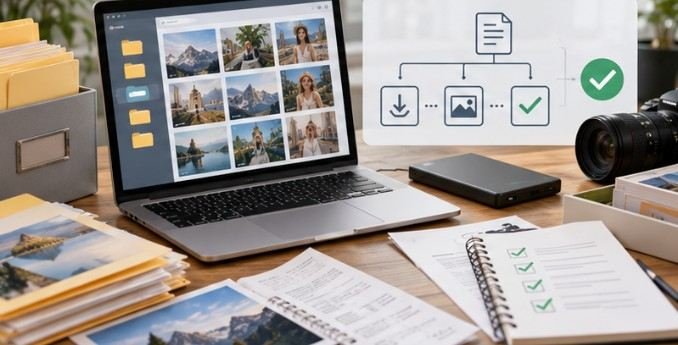
Search engines help locate images; they do not normally grant permission to reuse them. The U.S. Copyright Office advises that photographs on the internet remain protected and permission is generally required when using someone else’s photograph. Downloading a Google result and adding a photographer’s name underneath it does not create a commercial license.
Be Careful With the Fair Use Argument
Businesses sometimes assume that cropping, adding text, changing colors, or posting only part of an image automatically creates fair use.
It does not.
U.S. law evaluates four factors, including the purpose of the use, the nature of the copyrighted work, how much was taken, and the effect on the work’s potential market. Commercial purpose is specifically one factor courts consider.
Stanford’s Copyright and Fair Use Center likewise notes that commercial uses are generally less likely to favor fair use than criticism, commentary, teaching, research, or similarly transformative purposes.
For routine advertising, licensing is usually far more predictable than building a campaign around a hoped-for fair-use defense.
Build Licensing Into Your Visual Content Workflow
Image rights should be checked while choosing creative assets, not five minutes before publication.
If your team already plans visual content for social media marketing, creates graphics using infographic design techniques, or develops a broader visual content marketing strategy, add a licensing checkpoint before an image enters the design stage.
It is much cheaper to reject an unsuitable photograph before the designer builds an entire campaign around it.
Frequently Asked Questions
1. Can stock photos be used in advertisements?
Yes, if the photograph carries a commercial license allowing advertising and any required model or property releases are in place. Editorial-only images usually require additional permission.
2. Do I need an extended license for social media?
Usually not for ordinary posts or ads, but agency rules vary. Extended licenses more commonly apply to high-volume reproduction, merchandise, templates, or resale products.
3. Is crediting the photographer enough for commercial use?
No. Attribution does not replace a required license. Credit is sufficient only when the applicable license specifically permits the use under those conditions.
4. How do I know how to license stock photos for commercial use safely?
Define your use, read the exact license, avoid editorial-only assets, confirm releases, review sensitive-use restrictions, and save documentation proving what rights you purchased.
The Permission Matters More Than the Download
A stock photograph can be downloaded in seconds, but the important part is the legal permission attached to it. Before publishing, ask one practical question: “Does this exact license cover this exact use?”
If the answer is unclear, do not rely on assumptions about royalty-free images, attribution, fair use, or the fact that an image appeared in a search result. Check the terms or obtain additional permission.
Businesses that treat image licensing as part of production—not as paperwork after production—can create faster, reuse assets more confidently, and avoid discovering after launch that their most visible campaign was built around a photograph they never had permission to use.